Weight Loss
Why Am I Gaining Belly Fat After 40? What Men Should Measure
- 40+ 5-Star Google Reviews
 LegitScript Certified
- On-Site CLIA-Certified LaboratoryOn-Site CLIA Lab
- Licensed Illinois Medical Practice
Most men gain belly fat after 40 because the body changed while the habits did not. Muscle declines, so you burn fewer calories. Insulin works harder, testosterone tends to run lower with age, and sleep, stress and alcohol add up. The extra fat settles in the abdomen as visceral fat, which carries more metabolic risk than fat elsewhere.
Last reviewed: October 2026.
The scale may barely move. The belt tells a different story. Here is what drives it and what to measure.
Why Am I Gaining Belly Fat After 40 if Nothing Changed?
You are gaining belly fat after 40 because the same meals and workouts now land on a body with less muscle and a different metabolism. Mayo Clinic explains that you lose muscle as you age, that the loss is worse if you are not physically active, and that loss of muscle mass slows how quickly the body burns calories. Eat the same as before and the surplus is stored, including as belly fat.
It is usually a stack of five drivers, each modest on its own:
- Muscle loss. Less muscle, lower daily calorie burn.
- Insulin resistance. More insulin needed for the same meal.
- Hormone shifts. Lower testosterone is associated with aging, obesity and abdominal fat.
- Sleep and stress. Both push fat toward the organs.
- Alcohol. Two drinks most nights adds up by Sunday.
Why Is Visceral Belly Fat More Dangerous Than Other Fat?
Visceral fat is more dangerous because it sits deep in the abdomen, lining the abdominal wall and wrapping around internal organs, rather than just under the skin. Cleveland Clinic links excess visceral fat to a higher risk of cardiovascular disease, diabetes and high cholesterol. The fat you can pinch is subcutaneous; visceral fat sits beneath it.
Mayo Clinic lists what a large amount of belly fat raises the risk of in men:
- High blood pressure and unhealthy blood fat levels
- High blood sugar and diabetes
- Heart disease and stroke
- Sleep apnea and fatty liver
- Certain cancers and early death from any cause
Two men at the same weight can carry very different risk. Where the fat sits is the story.
How Does Insulin Resistance Drive Belly Fat?
Insulin resistance means your cells respond less to insulin, so the body releases more of it to keep blood sugar in range, and visceral fat sits at the center of that loop. A review on testosterone and type 2 diabetes in PubMed reports that low testosterone is associated with, and predicts, type 2 diabetes and the metabolic syndrome, and that a substantial part of the link to insulin resistance runs through body fat, in particular abdominal visceral fat.
Fasting glucose alone is a narrow view. Read next to A1c and fasting insulin, it shows how your body handles fuel. Our guide to blood tests for men over 40 covers the full metabolic panel.
Does Low Testosterone Cause Belly Fat?
Testosterone and belly fat influence each other in both directions, so it is less a single cause than a cycle. The same PubMed review describes the testosterone and fat relationship as bidirectional, and reports that weight loss is associated with higher testosterone levels, lower fat mass and lower insulin resistance.
The detail matters. A 2022 CT imaging study of 1,453 men aged 22 to 84 found testosterone was associated with lower subcutaneous fat but not with visceral fat once metabolic syndrome factors were accounted for, and was positively associated with abdominal muscle. Testosterone tracks closely with muscle and metabolic health, so one hormone number says little on its own.
Read it next to SHBG, body composition, waist and metabolic markers. For the causes behind a low reading, see why testosterone levels run low. Any hormone treatment requires an evaluation and a prescription from a licensed provider, and it is not a substitute for addressing the metabolic picture.
How Do Sleep, Stress and Alcohol Add to Belly Fat?
Sleep loss, stress and alcohol all push fat in the same direction, toward the organs. Cleveland Clinic names all three among the contributors to visceral fat.
- Stress. Cleveland Clinic notes the stress hormone cortisol makes the body add to its store of visceral fat.
- Sleep. Insufficient rest puts stress on the body, and Cleveland Clinic ties that stress to more visceral fat. Mayo Clinic lists sleep apnea among the risks of belly fat. Snoring with daytime fatigue is worth a sleep evaluation, and our piece on why men over 40 feel tired all the time covers the overlap.
- Alcohol. Mayo Clinic says drinking too much alcohol of any kind can raise your risk for belly fat. Cleveland Clinic points to the empty calories.
How Do You Measure Belly Fat After 40?
Start with a tape measure. Mayo Clinic says a waist of more than 40 inches (102 centimeters) signals excess belly fat and a higher health risk in men. To measure it:
- Stand and wrap a tape measure around your bare stomach, just above the hip bone.
- Keep the tape snug without pressing into the skin.
- Relax, exhale, then read the number.
Cleveland Clinic adds two quick checks for men: a waist-to-hip ratio above 0.90 suggests abdominal obesity, and your waist should be no more than half your height.
Body Composition Test vs BMI: What Each Measure Tells You
A body composition test tells you what your weight is made of, while BMI only compares weight to height. The CDC states that BMI does not distinguish between fat, muscle and bone, and does not indicate where in the body a person carries fat. Each measure answers a different question:
| Measure | What it tells you | What it misses |
|---|---|---|
| Scale weight and BMI | Overall size relative to height; a quick screen | Muscle versus fat, and where the fat sits |
| Waist, waist-to-hip, waist-to-height | Abdominal fat and the risk tied to it | Visceral versus subcutaneous fat, and muscle |
| Body composition scan (such as InBody) | Estimates of lean mass, fat mass and a visceral fat level | Blood sugar, lipids and hormones |
| Blood markers (A1c, fasting insulin and glucose, lipids, testosterone, SHBG) | How your body handles fuel and hormones | Where fat is stored and how much muscle you carry |
Together they explain each other. A stable weight with a growing waist and falling lean mass is a different situation entirely. One set of numbers is a snapshot; repeating them over 90 days shows direction.
What Actually Reduces Visceral Fat?
The fundamentals reduce visceral fat when they protect muscle and metabolism, not just the scale. Cleveland Clinic notes that visceral fat is easier to lose than subcutaneous fat, and points to regular exercise, a Mediterranean or DASH style diet, better sleep, stress management and less alcohol. Mayo Clinic cites the federal recommendation of at least 150 minutes a week of moderate aerobic activity or 75 minutes of vigorous activity.
- Train for strength to protect the muscle that age takes first
- Match intake to the body you have now, not the one you had at 35
- Protect sleep and count alcohol honestly
- Remeasure waist, body composition and labs so effort is tied to data
If the scale has stopped responding, see why weight loss gets harder in midlife. Where hormones, insulin resistance or sleep are involved, the next step is evaluated by our clinical team, not guessed at.
How Alpha Refinery Approaches This
We start with measurement, not assumptions. In our experience, men who come in about belly fat rarely have one problem. The waist, the scan and the blood work usually point to two or three drivers at once, and the order to address them is the real question.
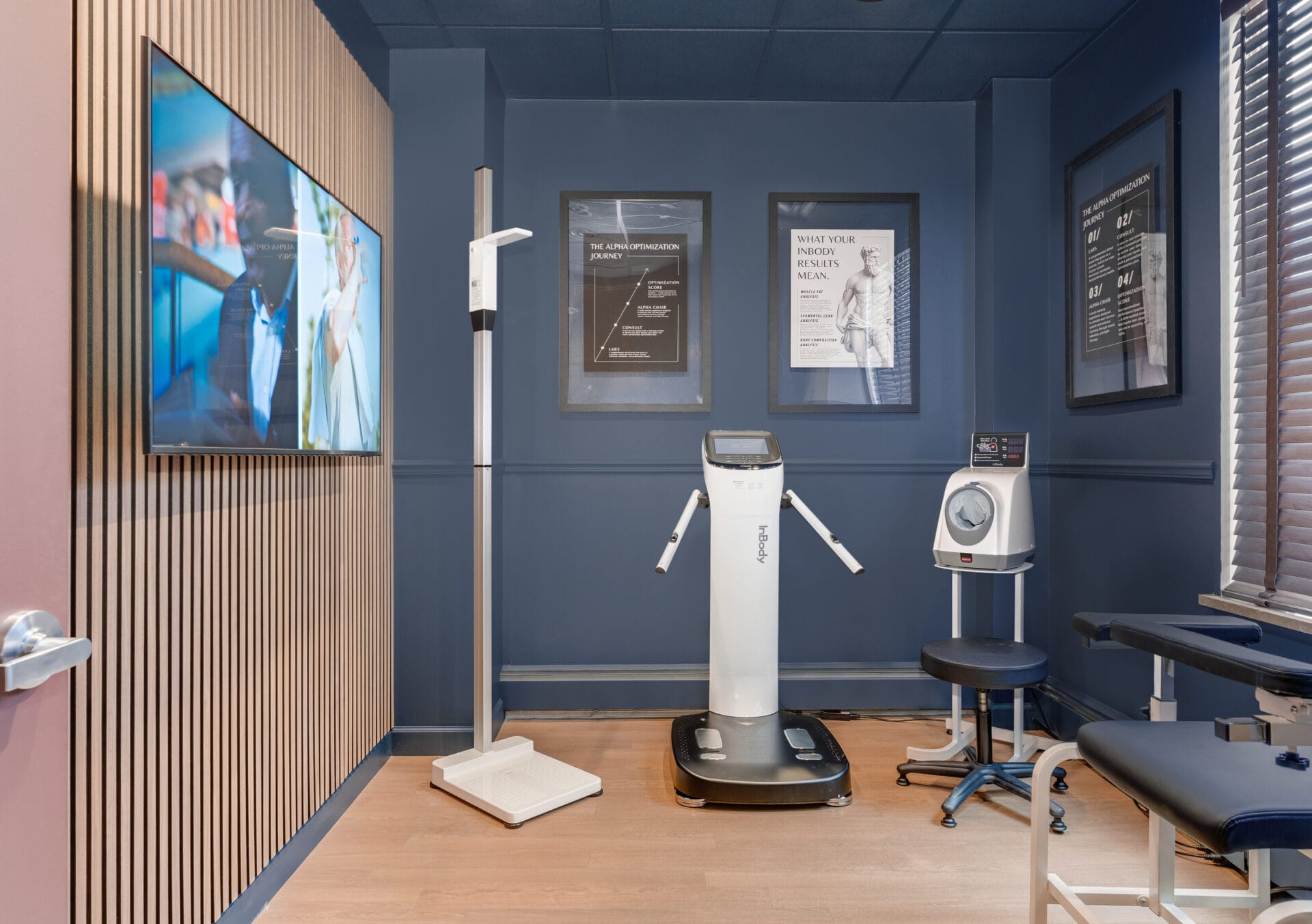
We record waist, blood pressure and grip strength, run an InBody 970 scan, and run blood biomarkers in our own CLIA-certified lab. Our clinical team reads composition, metabolic markers and hormones together, never one number in isolation. Key available findings are reviewed during the visit, remaining results follow as they become available, and the plan is a 90-day clinical protocol with the same measures repeated.
For men in Hinsdale, Oak Brook and Western Springs, that is what our expert-led performance medicine clinic, with physician medical oversight, is built around.
If your waist has grown while your habits held steady, start with two minutes. Take the Alpha Score, our free self-check. When you are ready for the full picture, the Alpha Performance Assessment is one private 90-minute visit with 61 blood biomarkers, InBody 970 body composition, grip strength and blood pressure, with nothing due to book. If weight is the main concern, see our medical weight loss program for men. Choose Your Time.
Common Questions
Is belly fat after 40 just normal aging?
It is common, but common is not harmless. The changes behind it, muscle loss, insulin resistance and hormone shifts, are measurable.
What waist size is too big for a man?
Mayo Clinic uses more than 40 inches as the marker of excess belly fat and higher health risk in men. A waist larger than half your height, or a waist-to-hip ratio above 0.90, are two more warning signs Cleveland Clinic uses.
Can you have visceral fat if you are not overweight?
Yes. The CDC notes BMI does not show where fat is stored, so a normal BMI does not rule out abdominal fat. Waist measurement and a body composition scan give a clearer view.
Is a body composition test better than BMI?
It tells you more, because it separates muscle from fat and estimates visceral fat, which BMI cannot do. The clearest picture combines it with waist and blood markers.
Key Takeaways
- Belly fat after 40 is often visceral fat, which carries more metabolic risk than fat under the skin.
- Same habits, different body: less muscle, more insulin resistance and hormone shifts change where fat goes.
- Testosterone and belly fat affect each other in both directions, and testosterone tracks closely with muscle.
- BMI cannot separate muscle from fat or show where fat sits; waist, a body composition scan and blood markers can.
- Repeated measures over 90 days show direction better than any single reading.
This article is for general education and is not medical advice. Treatment decisions are made by a licensed provider after an evaluation.
For general education only. This article is not medical advice and does not create a patient relationship. Whether any test or treatment is right for you is decided only after an evaluation by a licensed provider.