Weight Loss
Body Composition vs BMI: Which Matters More After 40?

- 40+ 5-Star Google Reviews
 LegitScript Certified
- On-Site CLIA-Certified LaboratoryOn-Site CLIA Lab
- Licensed Illinois Medical Practice
When comparing body composition vs BMI, body composition tells you far more. BMI divides weight by height and cannot separate fat from muscle or show where fat sits. A body composition test measures fat mass, lean mass and fat distribution directly, which matters most for men over 40, whose muscle and fat shift even when the scale holds steady.
Last reviewed: October 2026.
What is the difference between BMI and body composition?
BMI is a ratio of weight to height, while body composition is a measurement of what that weight is actually made of. One is a quick estimate. The other is a breakdown.
BMI takes your weight in kilograms and divides it by your height in meters squared. The result places you in a category: underweight, healthy weight, overweight or obesity. It requires no equipment beyond a scale and a tape measure, which is why it became the default in clinics and population studies.
Body composition splits total weight into its parts. Depending on the method, that can include:
- Fat mass and body fat percentage
- Lean mass, including skeletal muscle
- Total body water
- Where fat is distributed, including estimates of visceral (abdominal) fat
- Bone mineral content, with some methods
The CDC describes BMI as a quick, low-cost screening measure, and states plainly that BMI does not distinguish between fat, muscle and bone mass, and does not indicate where in the body people carry fat. That is the core of the issue.
Why is BMI often misleading for men over 40?
BMI is often misleading for men over 40 because it cannot see the trade between muscle and fat that tends to happen in midlife. Two men with the same height and weight can carry very different amounts of fat, and BMI scores them identically.
The clearest evidence comes from a study of 13,601 adults in the NHANES III dataset, published in the International Journal of Obesity in 2008. Researchers compared BMI against body fat percentage measured by bioelectrical impedance. In men:
- BMI flagged obesity (BMI of 30 or higher) in 19.1 percent of men.
- Body fat percentage flagged obesity in 43.9 percent of men.
- A BMI of 30 or higher detected only 36 percent of the men who had excess body fat by measurement.
In other words, BMI missed most of the men carrying too much fat. The authors also found that BMI’s accuracy diminished as age increased, and that in the 25 to 29.9 range, where many men in their 40s and 50s sit, BMI failed to tell fat apart from lean mass at all.
There is a second problem running the other way. A muscular man can register as “overweight” by BMI while carrying a healthy amount of fat. Neither error helps a man make a good decision about his health.
Which matters more for health: body composition or BMI?
For an individual, body composition matters more, because it measures the tissue that actually drives metabolic risk. BMI remains useful for tracking populations and as a first screen.
That position now has formal backing. In January 2025, a Lancet Diabetes and Endocrinology Commission of 58 experts, endorsed by 76 organizations worldwide, recommended that BMI be used only as a surrogate measure of risk at the population level, for epidemiological studies or for screening, not as an individual measure of health. The Commission recommended that excess body fat be confirmed by direct measurement of body fat where available, or by at least one body measurement such as waist circumference, waist-to-hip ratio or waist-to-height ratio, in addition to BMI.
The CDC makes a similar point: for individuals, BMI should be considered alongside other factors such as blood pressure, cholesterol levels and a physical examination.
| BMI | Body composition test | |
|---|---|---|
| What it measures | Weight relative to height | Fat mass, lean mass, water, fat distribution |
| Separates fat from muscle | No | Yes |
| Shows where fat is carried | No | Yes, with most methods |
| Best use | Population screening, first look | Individual assessment and tracking over time |
| Time and cost | Seconds, free | Minutes, varies by method |
What does a body composition test measure?
A body composition test measures how much of your weight is fat, how much is lean tissue, and how that tissue is distributed. The exact outputs depend on the method.
The most common methods include:
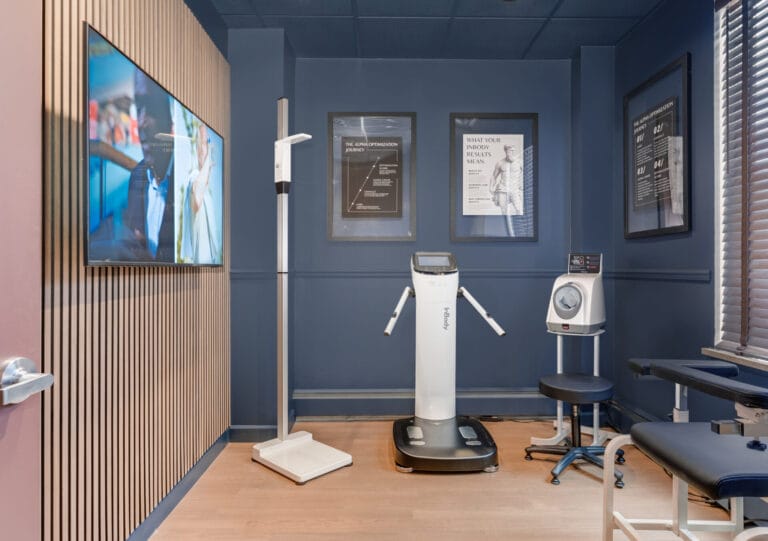
- Bioelectrical impedance analysis (BIA). A small, painless electrical current passes through the body. Lean tissue, which holds more water, conducts it differently than fat. Clinical multi-frequency devices such as the InBody series use eight contact points and report segmental results for each arm, each leg and the trunk.
- DXA (dual-energy X-ray absorptiometry). A low-dose X-ray scan, often used as the clinical reference for body fat and bone density.
- Anthropometric measures. Waist circumference, waist-to-hip ratio and waist-to-height ratio. Simple, but useful as an indicator of abdominal fat.
- Skinfold calipers. Inexpensive, but dependent on the skill of the person measuring.
Each method has trade-offs in accuracy, cost, access and repeatability. The right one is the one that will be done the same way, under the same conditions, each time you are measured.
How accurate is an InBody scan compared with DXA?
Clinical-grade multi-frequency BIA tracks closely with DXA at the group level, with some bias at the individual level. That makes it well suited to following change over time when conditions are consistent.
A 2021 study in the European Journal of Clinical Nutrition compared two multi-frequency BIA devices with DXA in 226 adults aged 18 to 80. Body fat percentage from the InBody 770 correlated strongly with DXA (a concordance of 0.922), but on average read body fat about 3.1 percentage points lower than DXA. The deviation was largest in people of normal weight and shrank at higher BMI. The authors advised caution when interpreting a single individual reading.
The practical takeaway: a BIA reading is most meaningful when it is compared with your own earlier readings, taken the same way, rather than treated as an exact number in isolation. Hydration, a recent meal and recent exercise can all shift a reading, which is why measurement conditions matter.
Why does body composition change after 40?
Body composition tends to shift in midlife because lean mass often declines while fat mass, especially around the abdomen, rises, sometimes with little change on the scale. This is why a stable weight can be misleading.
Several factors are commonly involved, and they tend to overlap:
- Lower daily activity and less resistance training
- Shorter or poorer sleep
- Changes in hormones, including testosterone
- Shifts in insulin sensitivity and blood sugar regulation
- Chronic stress and long work hours
A man who weighs what he did at 35 but has lost lean mass and gained abdominal fat has a different health picture than the scale suggests. If that pattern sounds familiar, our guide to why men gain belly fat after 40 walks through what to measure.
Should a man over 40 get a body composition test?
A body composition test is a reasonable step for a man over 40 who wants an accurate baseline, especially if his weight seems stable but his energy, waistline or strength has changed. It is most useful when read alongside blood work rather than on its own.
Body composition answers the question of what your weight is made of. Blood markers answer a different question: how your metabolism, hormones and cardiovascular system are functioning. A high body fat percentage paired with rising fasting glucose or an unfavorable lipid profile reads differently than the same body fat percentage with normal labs. Our article on which blood tests men over 40 should consider covers the panels that pair well with a body composition scan.
A few practical points if you get tested:
- Test under consistent conditions: same time of day, similar hydration, no hard workout beforehand.
- Use the same device for repeat measurements.
- Track the trend in lean mass and fat mass, not just body fat percentage.
- Have the results interpreted together with your labs and history.
How Alpha Refinery Approaches This
At Alpha Refinery in Hinsdale, body composition is one part of a broader measurement, not a standalone number. The Alpha Performance Assessment is one private 90-minute visit that includes:
- A body composition analysis on the InBody 970
- 61 blood biomarkers, drawn and run in our own CLIA-certified lab
- A review of history, symptoms and goals with our clinical team
Our clinical team reads these results together. Lean mass and fat distribution are considered alongside metabolic, hormonal and cardiovascular markers, so a single number is never interpreted in isolation. Key available findings are reviewed during the visit, and remaining results follow as they become available. From there, our clinical team outlines a 90-day clinical protocol. Any treatment requires an evaluation and a prescription from a licensed provider.
The Alpha Performance Assessment is $497, with nothing due to book. Men come to us from Hinsdale, Oak Brook, Naperville and across the western suburbs.
Where should you start?
If you want to know what your weight is actually made of, and what your blood markers say alongside it, the Alpha Performance Assessment gives you both in one visit. Choose Your Time. Not ready to book? Take the free two-minute Alpha Score self-check to see where you stand first. If weight is your main focus, see our medical weight loss program.
Common Questions
Is BMI accurate for men?
BMI is a reasonable population screen but often inaccurate for individual men. In a study of 13,601 adults, a BMI of 30 or higher identified only 36 percent of men who had excess body fat by measurement, and accuracy declined with age.
Is body composition better than BMI?
For assessing an individual, yes. Body composition separates fat from muscle and shows where fat is carried, which BMI cannot do. A 2025 international Commission recommended confirming excess body fat with direct measurement or a waist-based measure rather than relying on BMI alone.
What is a good body fat percentage for a man over 40?
Reference ranges vary by age, method and source, so there is no single correct number. The more useful questions are how your result compares with your own earlier measurements and how it reads alongside your blood markers, which our clinical team evaluates together.
How often should I get a body composition test?
Many people repeat a scan every few months to track change, using the same device under the same conditions. The interval that makes sense depends on your goals and is best set with your clinical team.
Can I be a normal BMI and still carry too much body fat?
Yes. Because BMI cannot distinguish fat from muscle, a man can fall in the healthy BMI range while carrying excess body fat and relatively little muscle. A body composition test is designed to reveal that pattern.
Key Takeaways
- BMI is a screening tool. It cannot separate fat from muscle or show where fat is carried.
- In men, BMI missed most cases of excess body fat in a large US study, and its accuracy fell with age.
- A 2025 Lancet Commission recommended confirming body fat with direct measurement or a waist-based measure, not BMI alone.
- Clinical BIA devices track closely with DXA and are best used to follow your own trend over time.
- Body composition is most useful when read together with blood markers by a clinical team.
This article is for general education and is not medical advice. Treatment decisions are made by a licensed provider after an evaluation.
For general education only. This article is not medical advice and does not create a patient relationship. Whether any test or treatment is right for you is decided only after an evaluation by a licensed provider.